

The AI Perception Management™ (AIPM) Manifesto
(2nd revised edition)
EYECONIFAY™ is Europe’s leading strategic consultancy for AI Perception Management™.
Operating from Belgrade, our international team of experts empowers executive leadership teams across European enterprises to maintain control over how AI systems represent their company - and minimize associated risks.
We serve industrial, technology, and service firms, as well as other high-trust industries.
Exclusively for Owners, CEOs, and C-Suite Leaders.
Customers, investors, procurement teams, partners, and employees increasingly use AI systems to research companies, compare alternatives, and form initial assessments. What AI systems say about a company can therefore influence decisions long before the company enters the conversation.
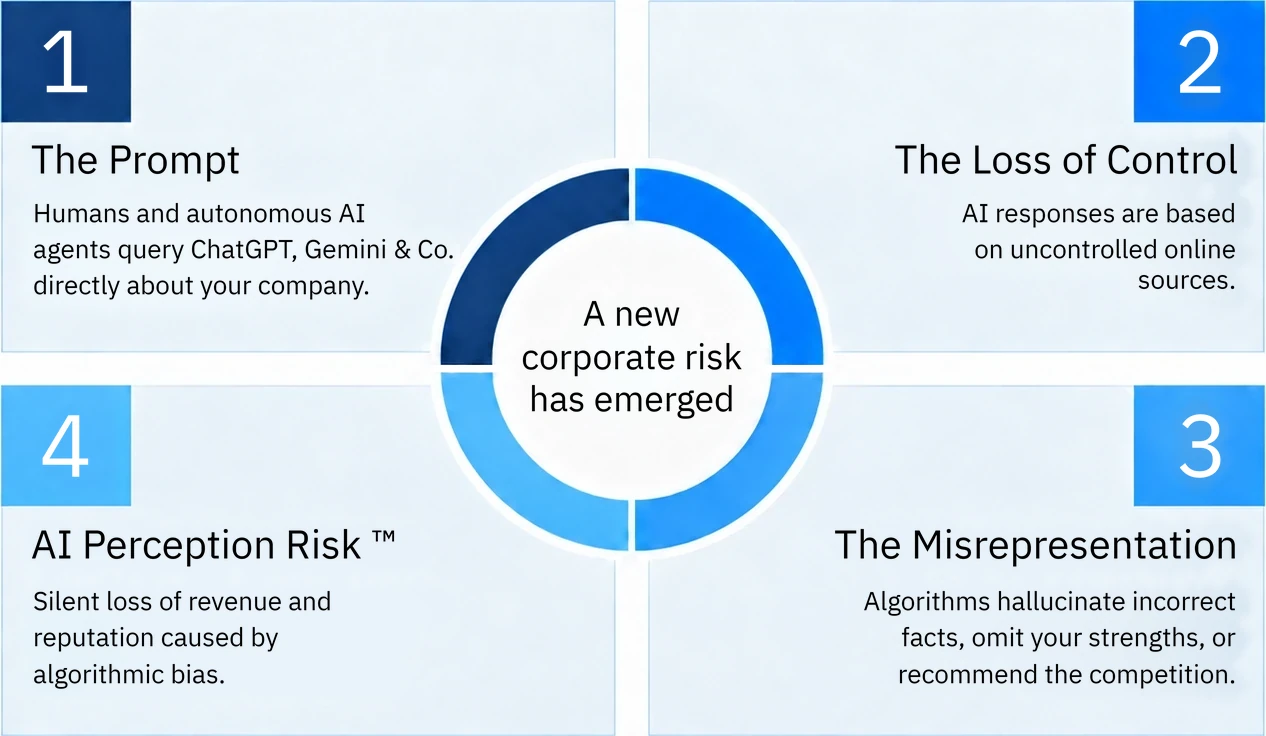
The answers generated by AI systems are based on information, sources, and signals that companies do not fully control.
An AI Perception Risk™ arises when the way a company is represented by AI systems begins to influence decisions about that company - while the company itself has only limited insight into and control over the information environment that shapes these answers.
AI Perception Risk™ thus becomes part of the broader enterprise risk and governance landscape.
The risk is not the AI answer.The risk is what can influence the answer.
An inaccurate AI response may appear insignificant in isolation. But when AI becomes part of how stakeholders research companies, evaluate alternatives, and make decisions, repeated inaccuracies can go beyond mere information quality.
They can influence:
This is why AI perception risk requires more than just monitoring.
Monitoring shows you what the AI is saying. AI Perception Management™ addresses the conditions that shape what the AI says.
EYECONIFAY™ analyzes the information environment surrounding an organization, identifies material perception gaps and risk vectors, and works to improve the conditions under which AI systems interpret and represent the company.
Not by controlling the AI. But by systematically managing the informational conditions that influence AI perception.
Exclusively for Owners, CEOs, and C-Suite Leaders.
AI-mediated decisions can influence whether a company is discovered, considered, compared, or recommended before any direct interaction takes place. The resulting commercial impact may remain invisible to management: an inquiry that never arrives, a company that does not appear on a shortlist, or a competitor that is presented as the more relevant alternative.
94%
of business buyers use AI in their buying process.
Source: Forrester, Buyers' Journey Survey 2025 (published Jan 2026)90%by 2028
Gartner predicts that by 2028, 90% of B2B buying will be AI-agent intermediated, routing over $15 trillion of spend through AI agent exchanges.
Source: Gartner, Top Strategic Predictions for 2026 (21 Oct 2025)45%
of AI assistant answers to news questions contained at least one significant issue.
Source: EBU & BBC, News Integrity in AI Assistants (Oct 2025): 22 public broadcasters, 18 countries, four leading AI assistants66%
of employees rely on AI output without evaluating its accuracy.
Source: University of Melbourne & KPMG, Trust, Attitudes and Use of AI (Apr 2025): 48,000+ respondents, 47 countries72%
of S&P 500 companies now disclose AI as a material risk in their annual filings, up from 12% in 2023.
Source: The Conference Board & ESGAUGE (6 Oct 2025), based on 10-K filingsAI-mediated decision-making processes create new forms of corporate exposure that traditional reputation management was not designed to address.
The erosion of an organization's own corporate authority through fragmented, misinterpreted, or algorithmically repurposed digital data sources.
The business-critical exposure driven by systematic misrepresentations, omissions, or distortions within AI-driven decision-making environments.
The loss of potential customers, partners, or investors prior to any human interaction - triggered by algorithmic filtering and altered perception.
Every material risk needs someone who is accountable for it. With AI Perception Risk, that person is usually missing. In large organizations, responsibility is fragmented across departments: a visibility issue in Marketing, a reputation issue in Communications, a liability question in Legal. In owner-managed companies, it lands on the desk of executive management - without a team, without a report, without a process.
In both cases, ultimate responsibility lies with the company’s leadership. And a risk that no one owns is not governed. It is discovered too late.
| Risk | Where It Shows Up | The Question for Executive Management |
|---|---|---|
| Financial | In inquiries that never arrive | How much revenue is lost before it ever reaches the pipeline? |
| Reputation | In the first impression of every new stakeholder | Which version of the company are AI systems presenting? |
| Operational | In the effort required to correct errors case by case | What does it cost to identify and correct AI misrepresentations individually? |
| Competitive | On AI-generated shortlists | Are we on them, and how are we positioned against alternatives? |
| Legal & Liability | In statements about products, ownership structures, and compliance | Where could inaccurate AI statements create material risks? |
AI Perception Management™ is not a communications issue. It is a corporate risk that, until now, has had no clear home.
AI Perception Management™ gives it what every material risk requires: transparency, accountability, and a governance framework - regardless of whether a company is led by a board of directors, executive management, or an owner-entrepreneur.
We do not control what AI systems say. We shape the conditions that influence what they say.
AI Perception Management™ becomes particularly relevant where trust, authority, complex purchasing decisions, and long evaluation cycles materially affect business outcomes.
The relevance of AI Perception Management is not defined by industry alone.
It becomes material wherever AI-mediated research can influence trust, consideration, procurement, investment, partnerships, or other consequential business decisions.
The greater the role of information and reputation in the decision process, the greater the importance of understanding how AI systems represent the organization.
Traditional reputation management was built primarily around human audiences. Today, AI systems increasingly interpret, summarize, compare, and recommend companies on behalf of the people who use them.
A growing market of AI visibility and monitoring solutions now focuses on measuring what AI systems say and how often a company appears. But visibility alone does not address the underlying conditions that shape AI perception.
This is where AI Perception Management™ begins: moving beyond observation toward the systematic management of the information environment, signals, and structural conditions that influence how AI systems interpret and represent a company.
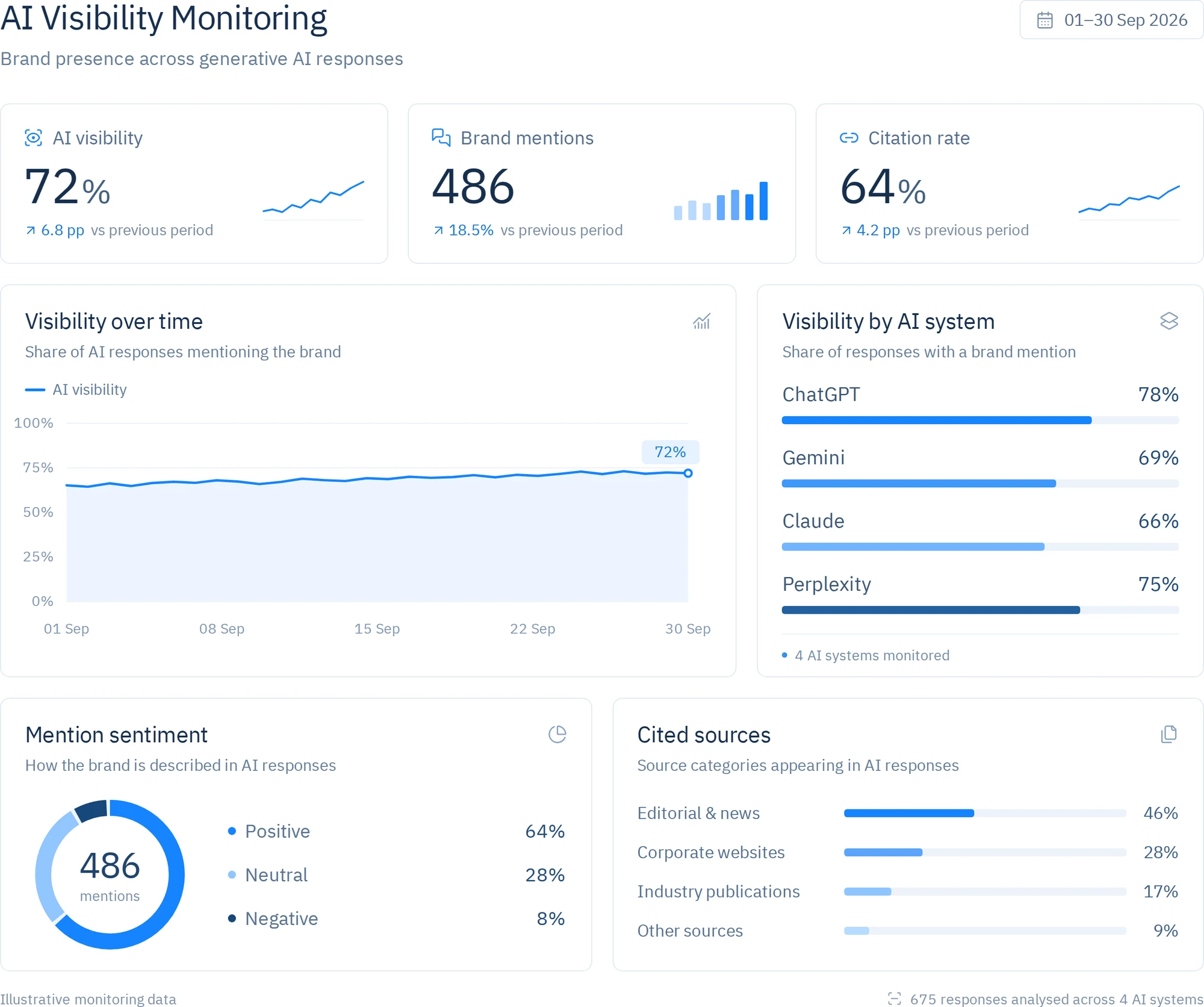
Generative AI systems are becoming an increasingly important intermediary layer between enterprises and their stakeholders.
The implications of this paradigm shift are already manifesting across AI-driven search environments, generative assistants, automated due diligence, and machine-mediated market research.
EYECONIFAY™ was founded on a fundamental strategic inquiry:
What happens when the information interfaces used to evaluate a company no longer simply index data - but synthesize and interpret corporate realities?
Our practice focuses exclusively on the commercial implications of this transformation.
AI Perception Management™ does not substitute for traditional public relations, SEO, corporate communications, or legacy reputation management.
It constitutes an overarching strategic governance layer that addresses how digital signals are interpreted and evaluated by increasingly autonomous AI systems.
Many companies already measure how visible they are across AI systems. That is a sensible first step. But with every risk that matters to corporate leadership, measurement leaves the decisive question unanswered.
| Risk | What Measurement Shows | What Remains Open |
|---|---|---|
| Financial | How often the company is mentioned. | Which inquiries, tenders, and contracts never materialized as a result - and what that costs. |
| Reputation | What individual AI answers currently say. | Which version of the company is repeated across systems and which sources generate it. |
| Operational | An alert for each individual error. | Whether the error is an isolated case or systemic, who reviews and corrects it, and at what cost. |
| Competitive | How the company performs against others across a selection of queries. | Why a competitor is recommended instead, and what the shortlist looks like in the respective market. |
| Legal & Liability | That a statement about the company is inaccurate. | Whether it is material, who needs to be informed, and how it is documented and escalated. |
| Dimension | What Measurement Shows | What Remains Open |
|---|---|---|
| Cause | That a statement exists. | Which sources and signals generate it and which of them the company can influence. |
| Accountability | A report for the operational team. | Who in corporate leadership is accountable for it and where the matter is reported. |
| Materiality | A list of findings. | Which findings are material and which are noise. |
| Time | A snapshot. | How models and sources change and when the picture shifts again. |
| Decision | Numbers. | What corporate leadership should decide and in what order. |
Measurement makes a deviation visible. What it costs, where it comes from, and who is accountable for it remain unanswered.
That is the gap between measurement and governance.
AI Perception Management™ closes that gap - not by controlling AI systems, but by shaping the conditions that influence what they say.
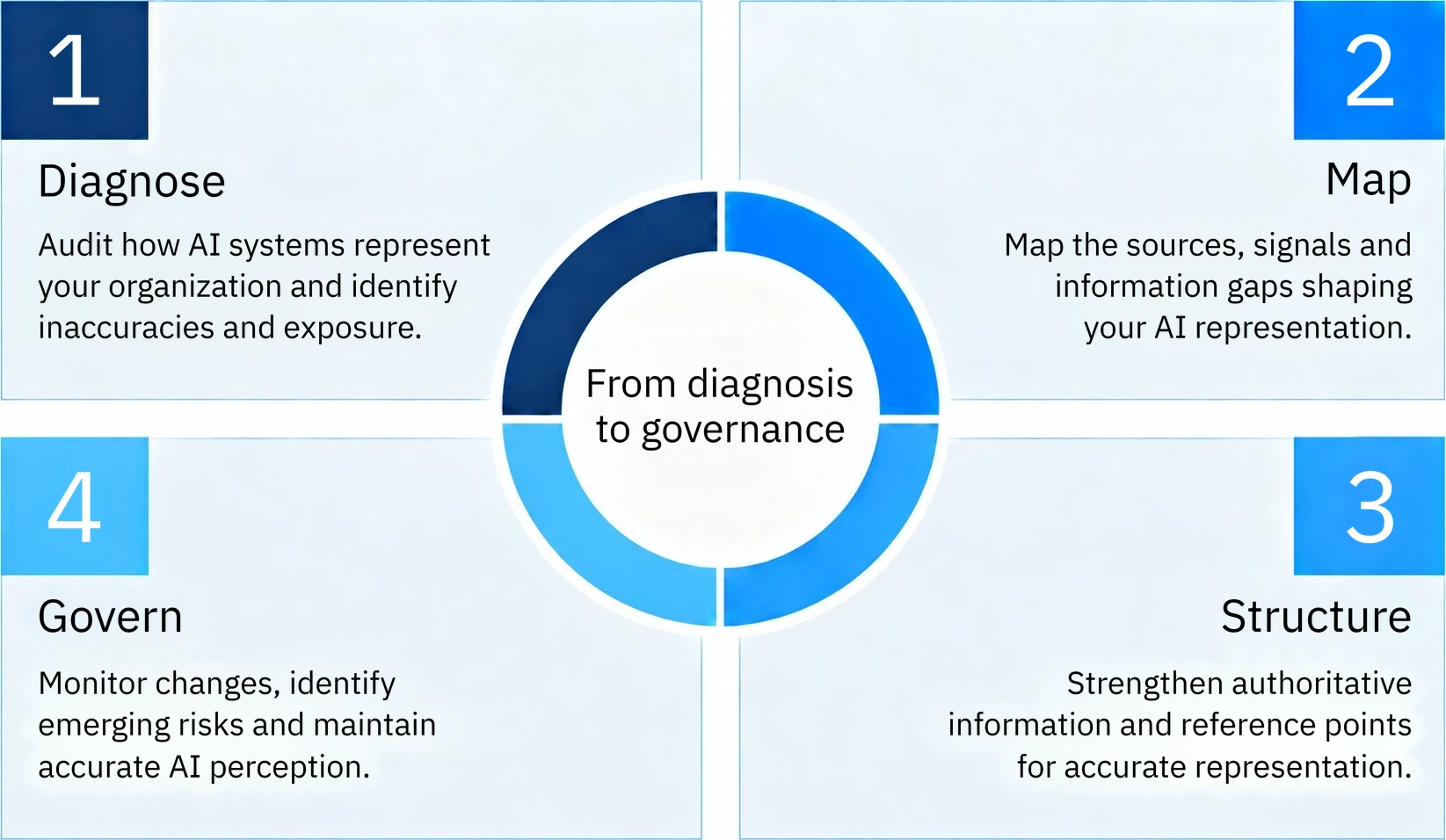
From diagnosis to governance.
AI Perception Management is not a single intervention. It requires a structured process for identifying how an organization is represented, understanding the information environment behind that representation, addressing material gaps, and maintaining governance as models, sources, and market conditions evolve.
Exclusively for Owners, CEOs, and C-Suite Leaders.
The boundary between passive exposure and active governance of your AI perception.
Leaving your AI perception entirely to the surrounding information environment means accepting limited visibility into how your company is interpreted and represented by AI systems.
AI systems may shape narratives and recommend competitors while your company becomes less visible or less relevant in AI-mediated comparisons (Invisible Churn™).
Inaccurate statements regarding products, compliance, or financial positions can persist across the information environment and influence how AI systems represent the company to third parties.
Post-hoc corrections can require significantly more time, budget, and resources, particularly once inaccurate or incomplete representations have already influenced stakeholder perception.
EYECONIFAY™ is a European strategic consultancy specializing in AI Perception Management™ (AIPM) - a discipline pioneered by founder Zeljko Perencevic to address the fundamental shift in how companies are understood, evaluated, and represented in the age of artificial intelligence.

If customers, investors, employees, or partners ask ChatGPT, Gemini, or Perplexity about your organization today - what do they hear?
EYECONIFAY™ assesses your current AI perception and identifies areas where inaccurate, incomplete, or inconsistent representations pose business risks.


























How AI evaluates your company is not a matter of chance, but increasingly the result of its surrounding digital information environment. The path to greater visibility, accuracy, and governance of your AI perception is structured, discreet, and focused on essentials.
Our process is designed to quickly identify business-critical risks in the AI environment, strengthen the conditions that influence AI perception, and sustainably safeguard your digital authority.
You submit an inquiry via our contact form. This forms the starting point for our preparatory analysis.
Our senior partners discuss your market position and strategic goals with you. Together, we evaluate informally where AI perception is currently critical for your business.
In advance, we analyze behind the scenes how leading AI models represent your company, where information gaps or risks lie, and what this means for your market. During the session, we present the concrete results and initial solution approaches directly to you.
Following the session, we jointly evaluate options for long-term engagement. Upon mutual fit, we directly initiate the implementation of our AIPM framework to actively steer your market position in the AI era.
Exclusively for Owners, CEOs, and C-Suite Leaders.
An Executive Risk Briefing is arranged during our introductory call, provided both sides see value in it. It takes place as a video call.
It is neither a casual presentation nor a sales pitch. It is a closed, in-depth working session of 90 to 120 minutes, based on a Preliminary Analysis prepared individually for your company beforehand.
We work through the findings together, in real time:
The session ends with a clear, fact-based decision on whether and in what capacity a collaboration makes sense. There is no obligation. The briefing is designed to give you an unvarnished picture of where your company stands.
Request an Executive Risk BriefingExclusively for Owners, CEOs, and C-Suite Leaders.
A briefing like this works only when someone with decision-making authority is at the table: an owner, CEO, managing director, board member, or an executive mandated by them.
The discussion is not about operational details or marketing metrics. It is about governance, risk, and strategic direction, and it calls for open dialogue on equal footing.
The first comprehensive analysis of corporate and brand vulnerability in the era of generative models.
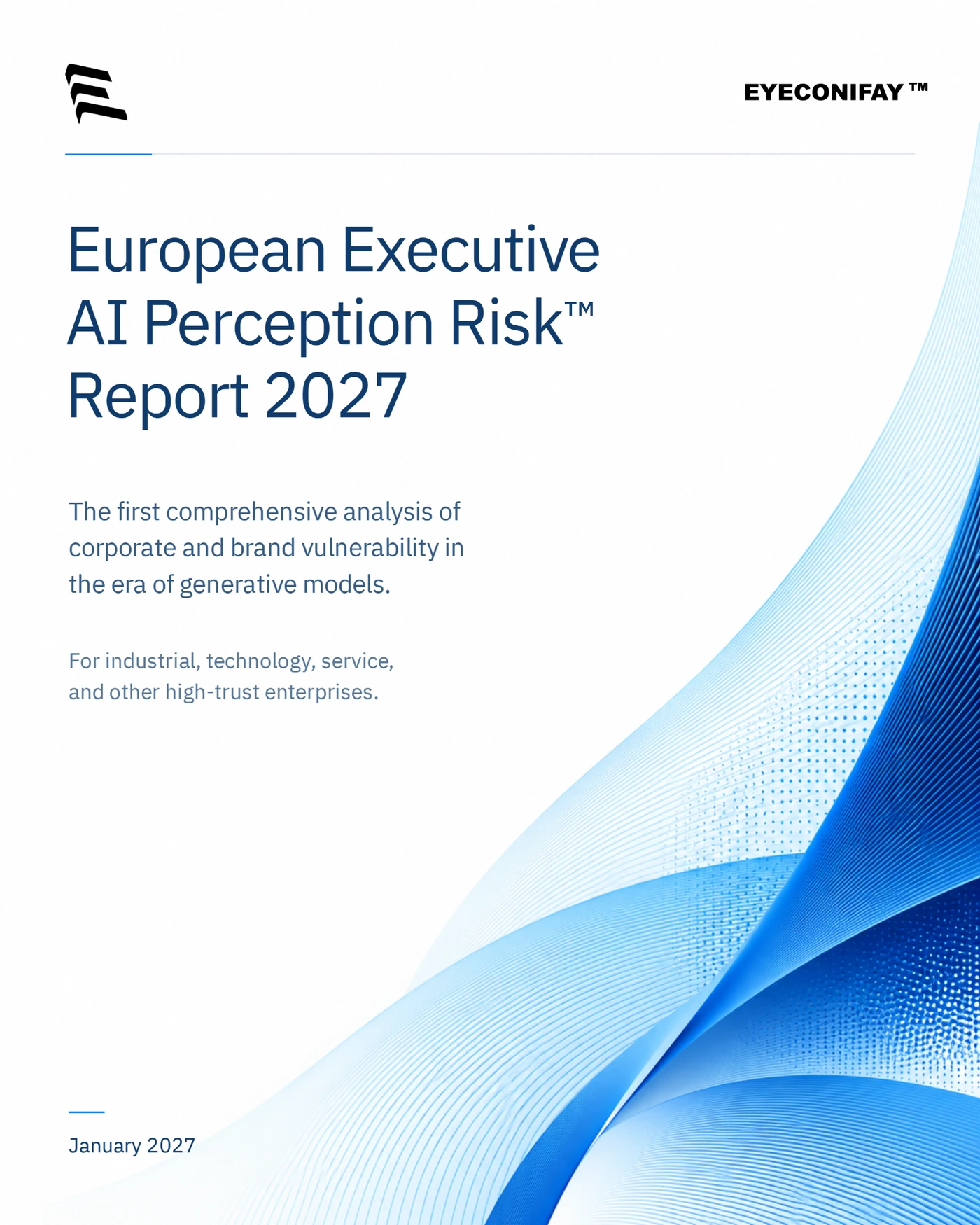
As the global economy transforms, European companies and organizations face an invisible risk: how AI models (LLMs) perceive, rank, and present them to decision-makers. This report delivers deep insight into the algorithmic reputation of companies in the region.
Where AI models most frequently hallucinate about regional leaders.
Identification of sectors losing algorithmic trust the fastest.
How brands rank within the AI ecosystem.
Concrete steps for safeguarding corporate sovereignty.
Be among the decision-makers to receive a copy of the report directly in your inbox.
Pre-order / Reservation